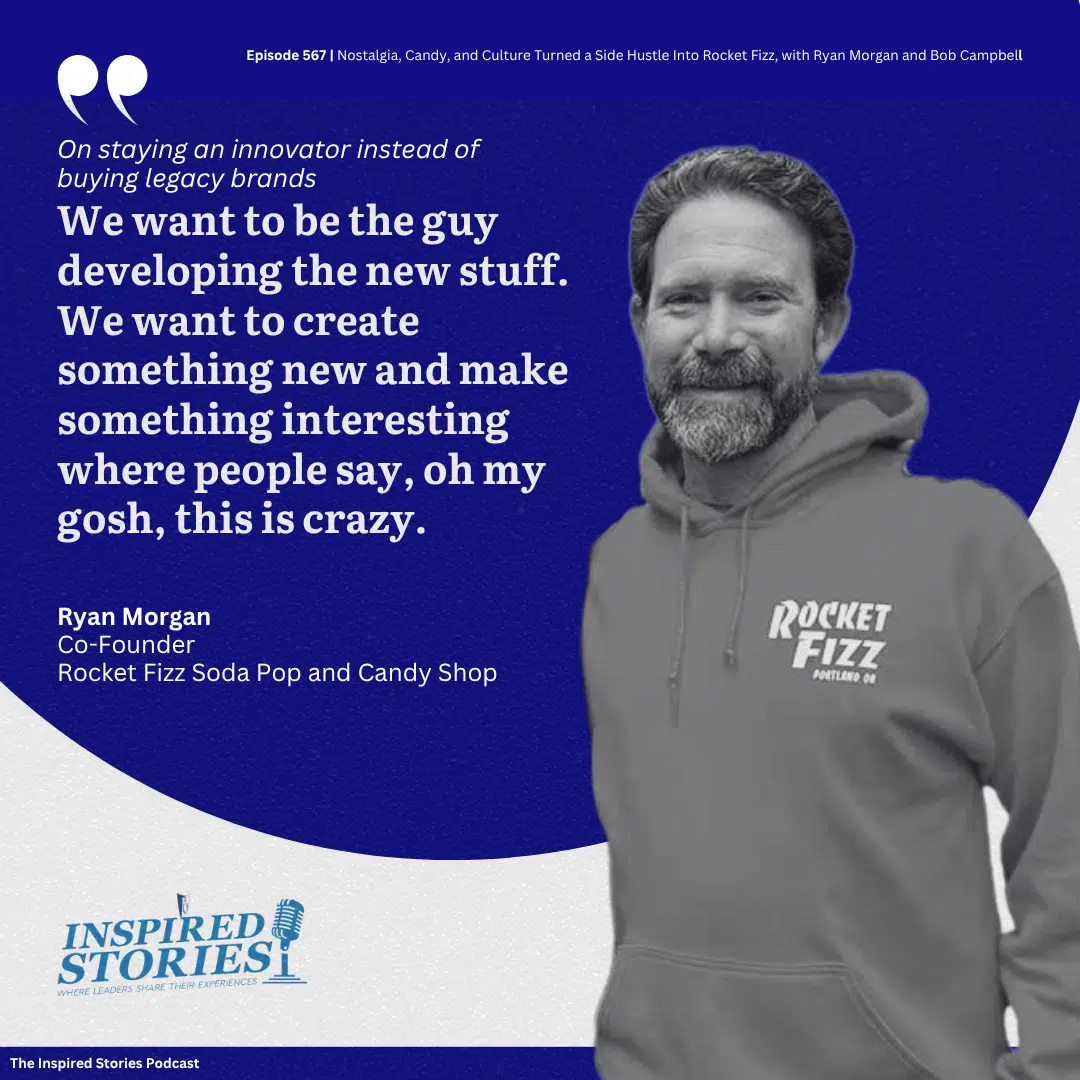
Founder Ryan Morgan and Bob Campbell, our VP of franchise development, sat down with Anthony Codispoti on the Inspired Stories podcast to talk about how Rocket Fizz started, why it worked, and what they’ve learned across 105 locations in North America. If you’re thinking about owning a Rocket Fizz, this is the most honest hour of homework you can do.
Prefer audio? Listen on Spotify or Apple Podcasts.
How did Rocket Fizz start?
With a pizza restaurant. In 1999, Ryan owned a pizza place next to Cal State Fullerton, and a persistent soda salesman finally talked him into shelf space for ten bottles. Within months the soda was outselling the pizza. Ryan started hauling in pallets of East Coast brands nobody on the West Coast had seen in years — Nehi was the first hit — and when the city tore up his parking lot for a redevelopment, he took the soda to the Orange County fairgrounds and then built a distribution company out of Reno.
The retail idea came on a two-hour delivery run, when his business partner Rob looked at the box truck full of soda and suggested a store. Ryan tested the concept with a tiny “soda museum” in Virginia City, Nevada — $600 a month rent, stocked with cleaned-up bottles from broken cases — and it worked well enough to prove the point.
Then the hard part. The 2005–06 downturn hit the distribution business: customers stopped paying, trucks wore out, and Ryan lost his house keeping the company alive. Building the first store in Camarillo took two years of permits. When the contractor vanished with roughly $100,000 of the buildout money, Ryan called five childhood friends who worked in construction, masonry, and carpentry, and they built the store themselves out of salvaged wood — which is why every Rocket Fizz still has that backyard-fort feel.
On opening day there was no sign on the building, just a paper one taped to the window. Ryan was on his knees painting the front door while customers stepped over him to get inside. The door stayed half-painted for a month. The store never emptied out.
Why nostalgia, not just candy?
The candy was actually an afterthought. The first store opened with soda and a box truck of novelty toys from the LA Toy Mart; the candy came when Ryan met Steve Corey of Garvey Nut and Candy, the biggest candy distributor on the West Coast, who became his most important business mentor and helped shape the product mix that defines the brand today.
But the real decision was about who the customer is. Early sales data said “35-year-old female,” because that’s who was at the register. Ryan and Rob ignored it. Rocket Fizz decided to build for every single demographic — and that’s still the strategy. Each store carries about 5,000 products drawn from a catalog of 25,000 to 30,000, so a five-year-old and a ninety-year-old both walk in and find something that’s theirs. The mix keeps evolving: imported Japanese and Asian candy is now one of the largest categories in the system.
That’s why the concept travels. Rocket Fizz stores thrive in regional malls, downtown districts, and ski towns — Vail, Breckenridge, Lake Tahoe — because the product is universal and the experience is something no online retailer can replicate.
What a first-year owner should know
This is where Bob gets specific, and it’s the part to listen to twice if you’re evaluating the opportunity.
- The learning curve is already paid for. The first store cost $350,000 and took two years. Today, once a location is secured, a store opens in about 30 days at a total investment that’s typically $165,000–$195,000 turnkey — inventory stocked, POS installed, construction and legal work done. Bob’s takeaway from Ryan’s story: that’s exactly why you buy a franchise instead of living through it yourself.
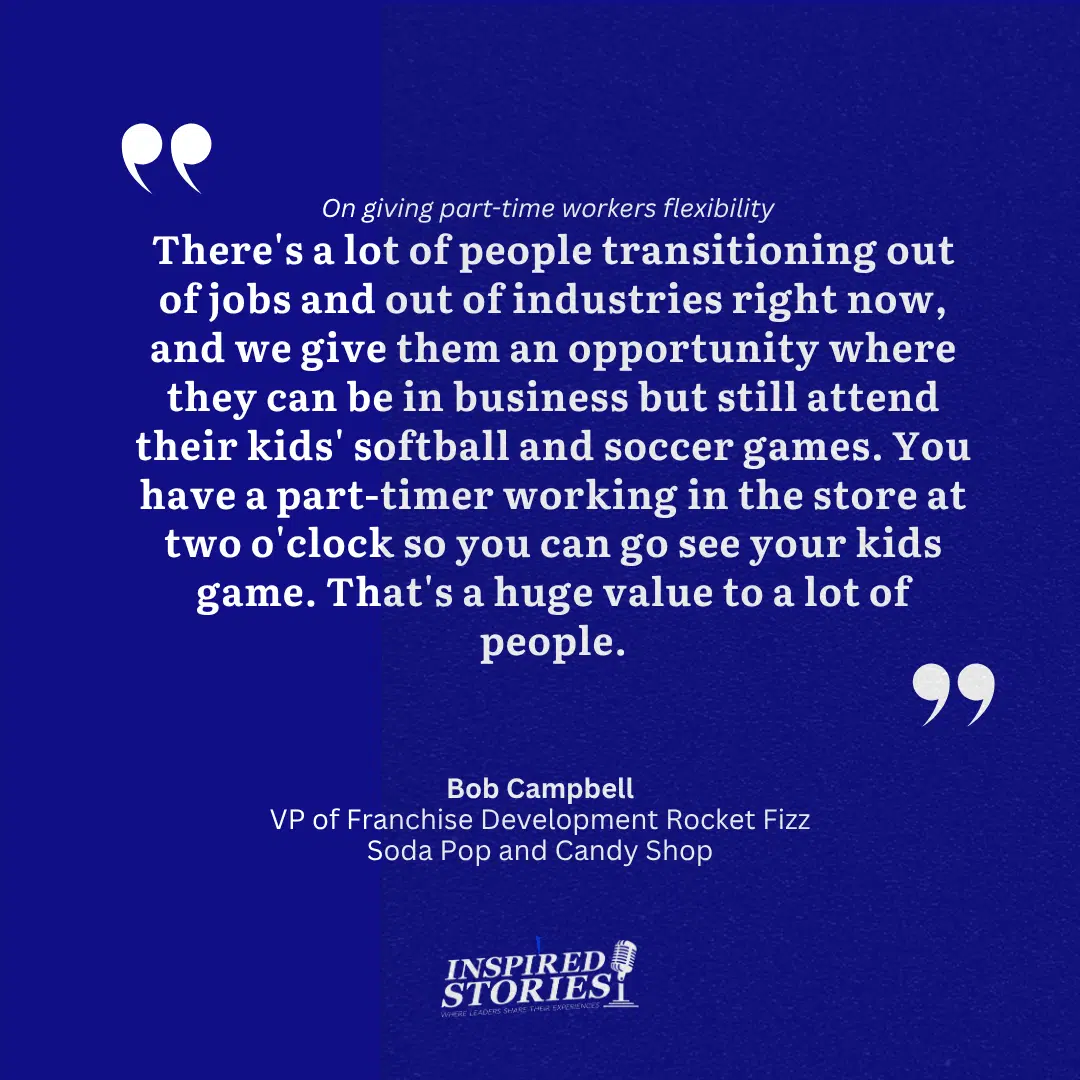
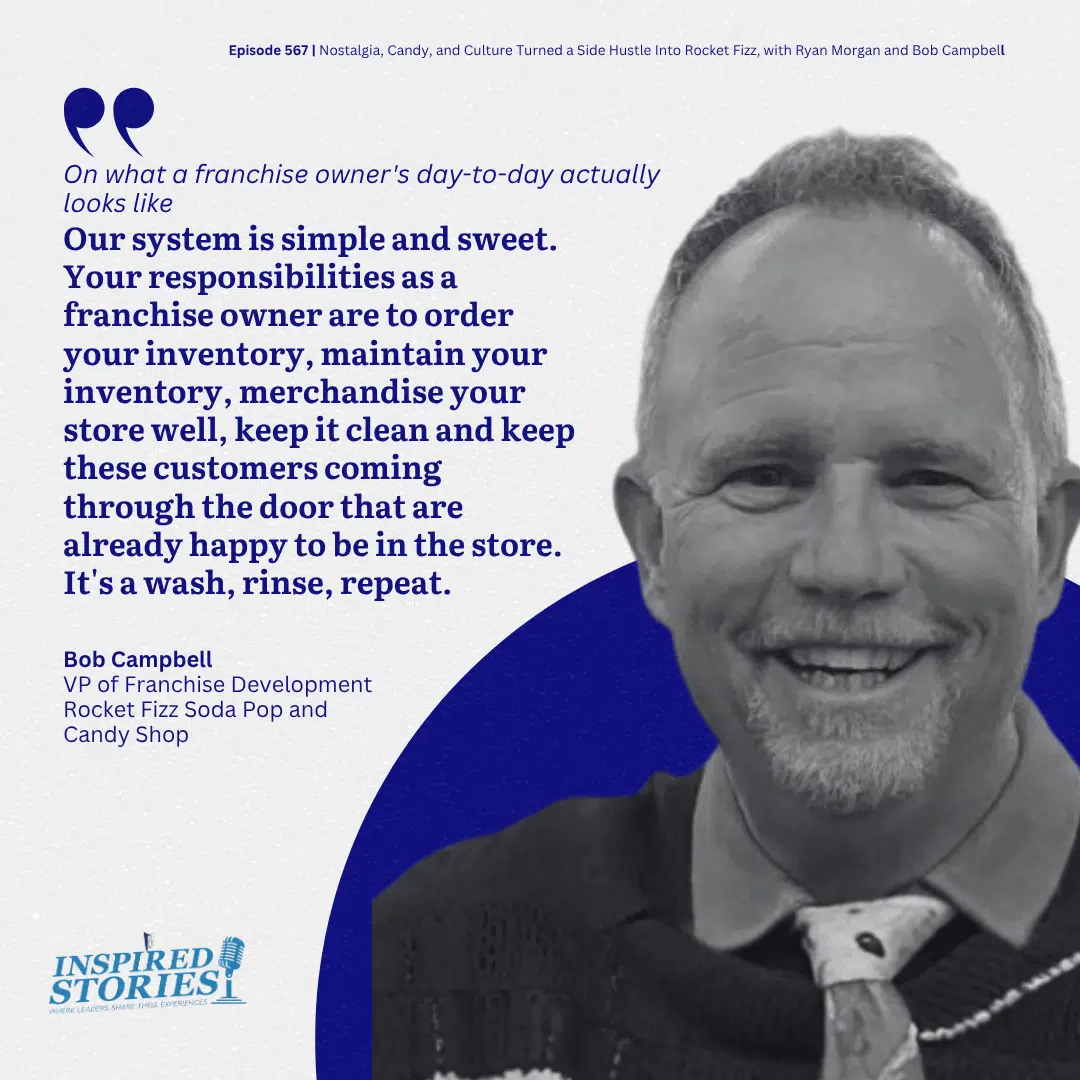
- The business is simple by design. Order inventory, merchandise the store well, keep it clean, and take care of customers who are already happy to be there. Two or three part-time employees is a normal staff, which is why many owners run a store and still make their kid’s 2 o’clock soccer game.
- It scales if you want it to — or doesn’t. The average location does about half a million dollars in sales, and the system has plenty of million-dollar stores. One owner is opening his 20th location; plenty of single-store owners are just as happy.
- Retail isn’t a restaurant. The single biggest lesson from the early years is inventory sequencing — having your opening product queued to arrive the moment construction finishes. That’s now built into the opening process.
- Where it’s headed. Rocket Fizz manufactures about 180 of its own soda flavors (starting with a bacon soda in 2011) and roughly a million pounds of taffy a year, with packaged candy next. The first New Jersey franchise agreement was just signed, and Northeast expansion is the priority — which means new territories are opening.
Is Rocket Fizz the right franchise for you?
Our best owners tend to share a few things: they like people, they like their town, and they want a business that’s fun to walk into every morning. They don’t need candy expertise — the product, the buying relationships, and the store design are handled. They bring the energy.
If that sounds like you, listen to the episode, then let’s talk. Explore franchise opportunities
Our thanks to Anthony Codispoti and the Inspired Stories podcast for the conversation.